Saturday, March 18, 2006

Kids Love the Kitchen


As a kid, I loved to be in the kitchen when my mother was cooking. Kitchens are where everything happens. It’s not just where meals are prepared – it’s usually the hub of the home, where family and friends get together to spend time. Cooking and eating together is about more than nutrition for the body. It’s also the experience of connecting and interacting with family members, to feed relationships. Try to choose one meal that everyone comes to the table. It doesn’t have to be dinner. This is a challenge as everyone has their own activities (especially as children grow), but starting early promotes the importance of family time together, and also demonstrates a healthy attitude towards food and eating.
Peeling of onions and garlic cloves were one of the few tasks I learnt at that time. This is so because I did not have to use a knife. I know all kids love being involved with preparing food. That is why they are so likely to get in the way in your kitchen. They're interested in what you're doing, while you may be ignoring them. So rather than push them away, draw them in. While you are cooking, teach your child what a recipe is and the importance of following directions in order for a dish to turn out right. Teach them mathematics in the kitchen!! Ask you child “How many half cups do you need to equal a whole cup?” Ask him to measure “2 cm of ginger” or weigh “500 g of flour”. Teach him the skills of doing work in sequence. You may be able to create a sensory awareness in you kid by teaching him using a variety of textures, tastes, smells. Let him taste and smell. Let him touch and feel.
You can be an English teacher right in the kitchen. Teach your child new words like the ingredients used in the cooking, the cooking terms eg, frying, braising etc. And show off your science skills. Teach your child why protein turns white after cooking or why bananas turn brown after being exposed to air for a long time. You child will learn team work when working in the kitchen with you. Teach your child all about hygiene in the kitchen and about bacteria and germs. And don’t forget that you can teach your child history and geography from the kitchen too. It’s good if you can set an example by referring to a cookbook for recipes. Children learn just by seeing that their parents use books as references.
Research shows that children who grew up helping their mothers in the kitchen grew up to be adults who are confident, helpful and happy.

Chocolates, women's favourite


Since I was a kid, I always liked chocolates. I realized that most of my brothers were never interested in chocolates the way my sisters and I were. I used to wonder if this is so because of ‘culture’. We seldom give chocolates as a gift to men but women are so used to receiving chocolates. What is it about chocolate that is so wonderful? I believe you enjoy chocolate just as much as me right? It always feels so nice to have it melted in your mouth, delivering its wonderful taste right through your tongue, right?
Chocolate is the perfect mix of sugar and fat to turn on almost every appetite triggering nerve chemical in the brain. The sugar in chocolate sparks the release of a nerve chemical called serotonin and might lower another nerve chemical called NPY; the end result is a sense of well-being – the way we always feel when eating chocolates. The sweet taste also releases endorphins in the brain, giving us an immediate euphoric rush. The fat in chocolate enhances flavour and aroma.
Chocolate contains caffeine that provides a mental boost and phenylethylamine which stimulates the nervous system, increases blood pressure and heart rate, and is suspected to produce similar feelings experienced when a person is "in love." Chocolate also contains a substance called anandamide that sort of gives you the effects of marijuana and boosts the pleasure you get when you eat chocolate hahahha……….
My friend a food writer argues with me that craving for chocolate is really the body's craving for nutrients, such as magnesium. But I argued with her that if that is the case than why don’t people crave for peanuts or other magnesium-rich foods? I think that chocolate cravings usually can be satisfied only by chocolate.
Sinful is how women has always described chocolate. But despite that it seems that 99% of all women love chocolate. As for me, I need to go for a Kit Kat break now! mmmmmmmm………..you want some?

Thursday, March 16, 2006

How to make great finger chips?

CHILLI FINGER CHIPS
Finger chips are quick to prepare and are a low food cost. They're popular all year round, any time of day or night. To make good finger chips the potatoes need a high solid content to ensure a distinct, mealy texture and hearty flavour as they also absorb less oil, producing crispier fries. This low moisture content also means less shrinkage after frying. Russet potatoes will produce good finger chips. You can enhance the homemade appearance and flavour by not paring the potatoes.

500 g potatoes
salt
oil for deep frying
1 teaspoon chilli powder
1/2 teaspoon fine salt

METHOD
1. Scrub the potatoes clean and cut them into even sized finger like pieces. Soak the potato fingers in salted cold water for five minutes and wash or twice, drain and pat dry before cooking to remove the excess starch that causes them to clump together (and from keeping them from sticking to the pan while cooking).
2. Spread over a towel to remove excess moisture to avoid water spattering and to reduce fat absorption
3. Heat oil. Always use clean oil to fry potatoes. Make sure oil is the proper temperature. Frying potatoes in cold oil will result in more oil absorption by the chips. When the chips don't sink when dropped in and bubbles remain on top of the oil it means the oil is in the right temperature.
4. I personally found the chips get a crispier finish if I blanch the chips in hot oil to pre-cook and then finish them in a final fry before serving. The finger chips are completely cooked during the blanching stage where a lower temperature is recommended to allow the potato to cook slowly without becoming golden brown. After blanching, allow the chips to cool to room temperature or, preferably, refrigerate fries in uncovered containers.
5. Fry until golden brown.
6. Drain on absorbent paper. While it is still hot, sprinkle with chilli powder and salt and toss well.

Note: Very good finger food..........taste better when eaten with the fingers ;-)

My fingers - the best utensils

My mother would break up small morsels of food with her fingers before feeding it to me when I was very young. I trusted the love that was transmitted through her fingertips. I could eat everything that she fed me coz I knew it was the right temperature and that it won’t burn my mouth; the food would have been broken to fit my mouth and mixed with the right amount of curry so that I could swallow the food and make it slide down my esophagus. I am one of those who believe that Indian food should be eaten with the fingers. Eating Indian food with our fingers improves the taste of the food greatly.
Eating with the fingers is sensual and liberating. According to traditional Indians one's taste buds can actually get awakened with the touch of one's fingertips. We are not just eating with the mouth alone, but also with the eyes, nose and fingers………. visual presentation, aroma and difference of textures are what make the difference between a good meal and a great one, right?
Our fingers are very sensitive to touch and so can help our enjoyment of food because not only are the fingertips centres of acupressure, but each fingertip relates to one element of the universe: air, water, earth, fire and ether. Another important reason is that our fingertips transmit emotions. Our fingers happen to be the most hygienic eating tools that we have.
And who said the other races don’t use their fingers? The Japanese use their fingers to eat sushi; the British eat their fish and chips with their fingers, the Americans eat their burgers and corn on the cob with their fingers and people from practically every country in the world use the fingers to eat something or another.
Well, to enjoy food, use your fingers. But keep your fingers clean, wash your hands before you eat. Keep nails short and if possible no nail varnish. Eat only food cooked with good authentic ingredients otherwise you end up with yellowed fingernails due to the use of adulterated ingredients in the cooking.
Well good food is always "finger licking good" not "spoon licking good" right? It's 'tastier' to lick our fingers than a metal spoon or fork.

Saturday, March 11, 2006

It's heavenly smelling or what?


Did you notice that when you walk down a shopping centre picking up the scent of freshly baked bread, coffee at Starbucks, the smell of durian or even popcorns, you will find yourself longing to eat these things. You will feel an appetite for food. I feel that somehow good food and smell seem to be linked to one another. But then on the other hand this does not necessarily mean that everything that smells good also tastes good right? For example, a rose smells so good, but it does not taste very good. But I guess whether a food product is edible or not is usually determined by its smell. After all burnt or rotten food does not smell very good. Ahhhhhhh……. It can be confusing. When I go to the market to buy seafood, the place stinks. When I am shelling the prawns or scaling the fish, the smell is not pleasant either. But the seafood taste fantastic after cooking! The smell of durian or some cheeses (like sweaty feet) can kill you but it taste so heavenly.But then I think whether people think something smell bad is very personal and culture related. Not everybody likes durian or asafoetida. And food that is tasty to some people, may smell terrible to people of another culture.We have heard of people saying 'you are what you eat'. I think this is so true! Try eating one teaspoon of fenugreek daily for 1 month and your whole body including your head will smell of fish curry! You will smell like what you eat. You may not know what you smell like but those around you who eat food that are different from yours will notice it. That’s why we hear remarks that “she always smell like curry” or “the Caucasian smells of butter and cheese” or the “Punjabis smell of ghee” etc. People who eat a lot of garlic will smell garlicky. So there you are, the next time you meet someone, focus on her smell and guess what she has been eating before she saw you I am very sensitive to smell. I notice stale foods, strong flavours or even the difference between different brands of flavoured foods. I can notice small changes o flavour and smell in food. But I have met people who never noticed the smell of food. The smell of petrol and paint can nauseate or kill me on the spot if I don’t move away from the situation. These smells can cause adverse reaction in my body eg. give me a terrible headache or cause me to vomit. My friends and relatives think I am overly fussy. It’s very difficult not to notice smells. What do you think?

Friday, March 10, 2006

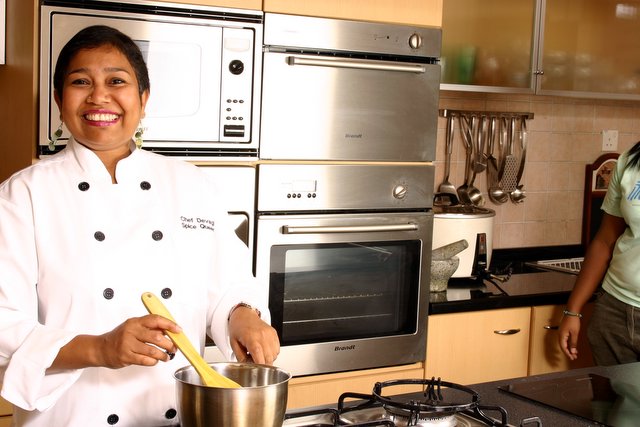
Spice Queen in the kitchen

 Posted by Picasa

what food means to me

Sometimes I wonder what it is that draws me to food. I think it's the colour. No, maybe it is the smell or the texture. Perhaps it is the shape. I really don't knoww. But food excites me. Even if it is presented in the worst way or in an artistic manner. I can't stand it if someone misuses a food ingredient eg. throwing of tomatoes or rotten eggs when he is unhappy with a performance. Or giving an orange to a kid to play. It's pure murder to a living thing! It's slow torture.
For me, food ingredients are alive! That's why the rot; they 'perspire' when you tie it up in a plastic bag. It's fascinating to keep a few unripe fruits in a basket and to watch it changing colour every day or even every hour eg. from a green banana to a ripe yellow banana.